
01 · Overview
Product context and engineering scope.
The goals, operating context, and technical decisions behind this case study.
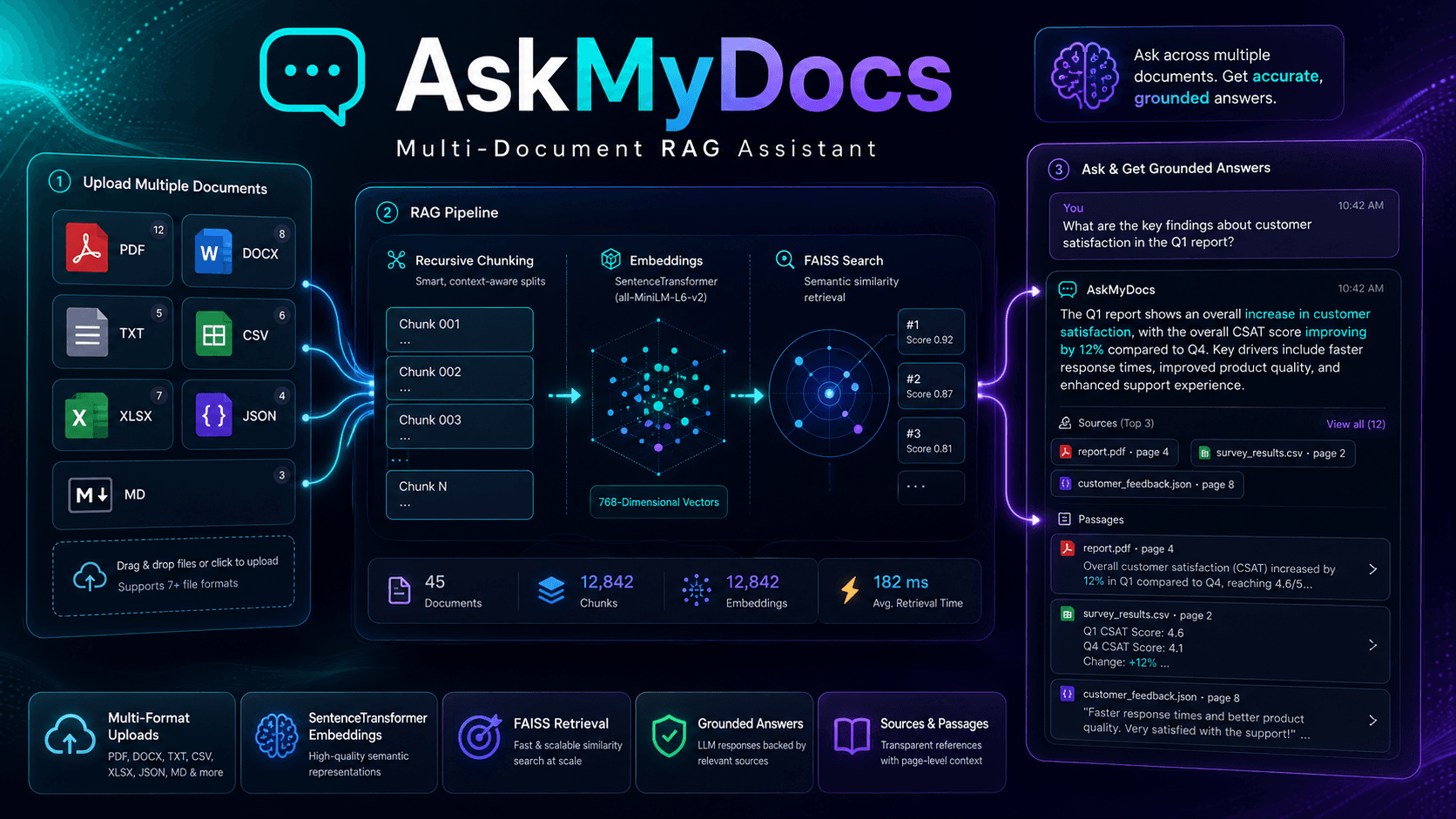
Built an end-to-end Retrieval-Augmented Generation application that allows users to upload multiple documents and ask natural-language questions about their content.
01
The ingestion pipeline supports PDF, TXT, Markdown, CSV, DOCX, XLSX, and JSON files. It converts uploaded content into LangChain documents, divides it into overlapping chunks, and preserves source metadata such as filenames and PDF page numbers.
02
SentenceTransformer embeddings and FAISS similarity search retrieve the most relevant document passages. Groq-hosted Llama models use the retrieved context to produce structured Markdown answers with source references and expandable supporting passages.
02 · Capabilities
Capabilities designed around real user needs.
The product features and system behaviors delivered by this project.
01
Multi-Format Document Ingestion
Loads multiple PDF, TXT, Markdown, CSV, Word, Excel, and JSON files into a unified document-processing pipeline.
02
Recursive Metadata-Aware Chunking
Splits long documents into overlapping retrieval-friendly chunks while preserving filenames, PDF page numbers, and source metadata.
03
Local SentenceTransformer Embeddings
Uses the all-MiniLM-L6-v2 model to generate semantic embeddings locally for document chunks and user questions.
04
FAISS Semantic Retrieval
Builds a session-isolated FAISS index and retrieves the document passages most semantically relevant to each question.
05
Grounded Groq Answers
Uses Groq-hosted Llama models through LangChain to generate formatted answers based only on retrieved document context.
06
Sources & Retrieved Passages
Displays source filenames, PDF page references, and expandable supporting passages alongside generated answers.
03 · Decisions
Constraints translated into engineering decisions.
The problems that shaped the product and the responses used to address them.
01
The constraint
Processing multiple document formats while maintaining consistent content and source metadata
Engineering decision
Normalized supported files into LangChain Document objects and preserved metadata throughout loading, chunking, vector indexing, and retrieval.
02
The constraint
Generating useful answers without introducing information unsupported by the uploaded documents
Engineering decision
Implemented semantic top-k retrieval and a grounded system prompt that restricts the Groq model to retrieved context and requires matching source references.
03
The constraint
Safely handling user documents and API credentials within an interactive application
Engineering decision
Created isolated temporary workspaces for uploaded files and FAISS indexes while keeping the user-provided Groq API key only in Streamlit session memory.
04 · Technology
Technology and tools
The complete technology stack utilized in this project, organized by engineering area.
More selected work
Continue exploring the portfolio case studies.